Curcumin, the active compound in turmeric, is one of the most researched natural substances in the world—with over 10,000 peer-reviewed studies. Yet many people take curcumin supplements that provide virtually no benefit because they don't understand the absorption problem. This guide explains the science and how to actually benefit from this remarkable compound.
Turmeric vs. Curcumin: What's the Difference?
These terms are often used interchangeably, but they're not the same:
- Turmeric: The whole spice from the Curcuma longa plant (what you buy in the spice aisle)
- Curcuminoids: The active compounds in turmeric responsible for health benefits
- Curcumin: The primary and most studied curcuminoid (about 77% of curcuminoids)
Here's the critical point: turmeric contains only 2-5% curcuminoids by weight. To get the doses used in clinical studies, you'd need to consume impractical amounts of turmeric powder. This is why curcumin supplements use concentrated extracts.
The Curcumin Absorption Problem
Curcumin has a fundamental challenge: it's poorly absorbed by the body. Here's why:
Poor Bioavailability Issues
- Fat-soluble: Curcumin doesn't dissolve well in water (and your digestive tract is mostly water)
- Rapid metabolism: The liver quickly converts curcumin to inactive metabolites
- Rapid elimination: What little is absorbed is quickly excreted
- Poor intestinal absorption: Curcumin has difficulty crossing the intestinal barrier
The result? Standard curcumin supplements may result in blood levels of essentially zero within hours of ingestion. Most of it passes through you without ever entering systemic circulation.
Solutions: How to Actually Absorb Curcumin
BioPerine® (Black Pepper Extract)
Enhancement: Up to 2000% increased absorption
Piperine (the active compound in black pepper) inhibits glucuronidation—the liver process that deactivates curcumin. By slowing this process, curcumin stays active in the bloodstream much longer.
A landmark study published in Planta Medica demonstrated that 20mg of piperine increased curcumin absorption by 2000%. This is why BioPerine is included in Curcumin 2000.
Other Absorption Technologies
Various technologies have been developed to improve curcumin absorption:
- Phospholipid complexes (Meriva): ~29x better absorption than standard
- Nano-emulsions: Smaller particles for better absorption
- BCM-95: Curcumin combined with essential oils (~7x improvement)
- Theracurmin: Ultra-fine particle technology (~27x improvement)
BioPerine remains the most cost-effective and well-validated approach for most users.
Additional Absorption Tips
- Take with fat: Curcumin is fat-soluble; a meal with fat improves absorption
- Heat helps: Cooking turmeric increases bioavailability (for food use)
- Quercetin synergy: May inhibit the same liver enzymes as piperine
Evidence-Based Benefits of Curcumin
Anti-Inflammatory Effects
Evidence Level: Extremely Strong
Chronic inflammation is linked to virtually every major disease—heart disease, cancer, diabetes, Alzheimer's, arthritis. Curcumin is one of nature's most potent anti-inflammatory compounds.
Curcumin inhibits NF-κB, a molecule that travels to cell nuclei and activates genes related to inflammation. Many pharmaceutical anti-inflammatories target this same pathway.
Studies show curcumin is as effective as some anti-inflammatory drugs for conditions like arthritis—without the gastrointestinal side effects.
Joint Health
Evidence Level: Strong
Multiple clinical trials show curcumin significantly improves symptoms of osteoarthritis:
- Reduced pain scores comparable to ibuprofen
- Improved physical function and mobility
- Decreased inflammatory markers in joint fluid
- No gastrointestinal damage (unlike NSAIDs)
Curcumin pairs well with Joint Advance (glucosamine, chondroitin, MSM) for comprehensive joint support.
Brain Health & Neuroprotection
Evidence Level: Moderate to Good
Curcumin crosses the blood-brain barrier and has shown neuroprotective properties:
- Increases BDNF (Brain-Derived Neurotrophic Factor), supporting neuron growth
- Reduces oxidative stress and inflammation in the brain
- May help clear amyloid plaques associated with Alzheimer's
- Clinical trials show improvements in memory and attention
Mood & Depression
Evidence Level: Moderate
Studies in people with major depressive disorder show curcumin supplementation significantly improves depression symptoms, comparable to some antidepressants. It may work by:
- Increasing serotonin and dopamine levels
- Reducing inflammation (which is linked to depression)
- Increasing BDNF levels
Cardiovascular Health
Evidence Level: Moderate
Curcumin improves endothelial function (the lining of blood vessels), which is crucial for cardiovascular health. Studies show improvements comparable to exercise in some measures. It also reduces LDL oxidation, inflammation, and may improve lipid profiles.
Antioxidant Power
Evidence Level: Strong
Curcumin is a potent antioxidant that:
- Directly neutralizes free radicals
- Stimulates the body's own antioxidant enzymes (SOD, catalase, glutathione)
- Protects cells from oxidative damage
Proper Dosage
For General Health & Prevention
500-1000mg of curcuminoids daily with BioPerine
For Joint Pain & Inflammation
1000-2000mg of curcuminoids daily, divided into 2 doses
For Specific Conditions
Studies have used doses ranging from 500mg to 8000mg daily. Higher doses may require medical supervision. Most benefits are seen in the 1000-2000mg range.
Duration
Acute effects (mood, cognition) may appear within 1-2 weeks. Anti-inflammatory benefits for joints typically take 4-8 weeks. Continue indefinitely for ongoing support.
Safety & Side Effects
Curcumin has an excellent safety profile. Common considerations:
Generally Safe
- Used for thousands of years in traditional medicine
- Clinical trials up to 12g daily showed no significant adverse effects
- Most common side effect: mild digestive upset at high doses
Potential Interactions
- Blood thinners: Curcumin has mild anticoagulant properties; stop 2 weeks before surgery
- Diabetes medications: May enhance blood sugar-lowering effects
- Gallbladder disease: Curcumin stimulates bile production; avoid if you have gallstones
Pregnancy
Culinary amounts of turmeric are safe. High-dose curcumin supplements are NOT recommended during pregnancy as they may stimulate uterine contractions.
Choosing a Curcumin Supplement
What to Look For
- Standardization: 95% curcuminoids (the active compounds)
- Absorption enhancer: BioPerine (piperine) or equivalent technology
- Adequate dose: 1000mg+ curcuminoids for therapeutic effects
- Third-party testing: Verification of contents and purity
What to Avoid
- Products listing just "turmeric" without curcumin standardization
- No absorption enhancer included
- Low doses (under 500mg curcuminoids)
- Proprietary blends hiding actual amounts
My Recommendation
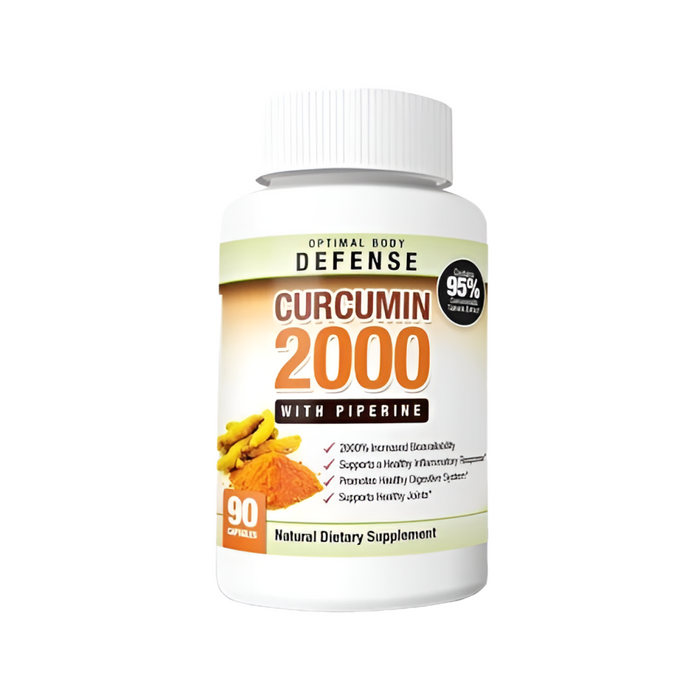
Curcumin 2000 provides 1000mg of turmeric extract standardized to 95% curcuminoids plus 10mg BioPerine for 2000% enhanced absorption. It delivers clinical-grade curcumin at an effective dose.
Conclusion
Curcumin is one of the most well-researched natural compounds with genuine benefits for inflammation, joint health, brain function, and more. However, the absorption problem means many supplements are essentially useless.
Choose a product with proper standardization (95% curcuminoids) and an absorption enhancer (BioPerine). Take it with a meal containing fat. Give it 4-8 weeks for full benefits on joints and inflammation.
When used correctly, curcumin is a powerful, safe, natural tool for supporting your health at multiple levels.